"Jowls" is the word most people use for soft tissue that sags below the jawline, and the honest first answer is that not all jowls are the same. Skin laxity, lost volume and downward-shifting fat each call for a different approach, so working out which is happening comes before choosing a treatment.
Below we explain why the lower face changes, how to tell the main types apart, which non-surgical options are commonly considered for each, and what to ask before you book. If you are comparing devices, our pages on Ultherapy Prime and Thermage FLX describe how we use them at Gangnam Pieobom Dermatology Skin Clinic.
The short version
Jowls form when skin loosens, supporting ligaments relax, volume thins in the mid-face and fat shifts downward. Mild to moderate cases may be improved with non-surgical care chosen for the cause, such as energy-based lifting, thread lifting or carefully placed filler. Results vary, cannot be promised, and more advanced sagging may be better addressed by a surgeon.
What jowls are
- Appearance: soft fullness that hangs beside the chin and breaks the smooth line of the jaw.
- Where: along the lower cheek and jawline, often deepening the fold beside the mouth.
- When: they usually become noticeable gradually in adulthood, though timing differs widely.
- Related changes: a less defined jawline, a heavier look to the lower face and sometimes early neck laxity.
Why the lower face sags
Facial tissue is held up by skin, fat compartments and a network of supporting ligaments. With time, skin loses firmness, those ligaments loosen and the fat pads shift, while volume thins higher up in the cheeks. The result is that the lower face appears to drop. Sun exposure, weight changes and genetics influence how fast this happens, which is why two people of the same age can look quite different.

Telling the main types apart
| Main cause | What it tends to look like | Options a doctor may weigh |
|---|---|---|
| Skin and tissue laxity | Looseness along the jawline, softer contour | Energy-based lifting, thread lifting |
| Lost mid-face volume | Flattened cheeks with a lower face that looks heavier | Careful volume support in the cheeks, skin boosters |
| Lower-face fat | Fullness that stays even when the skin is firm | Fat-focused approaches, assessed individually |
| Muscle pull | Downward tension around the mouth and jaw | Selected anti-wrinkle injections as a supporting step |
Most people have more than one of these at once, which is why a single device or injection is rarely the whole answer.
Non-surgical options commonly considered
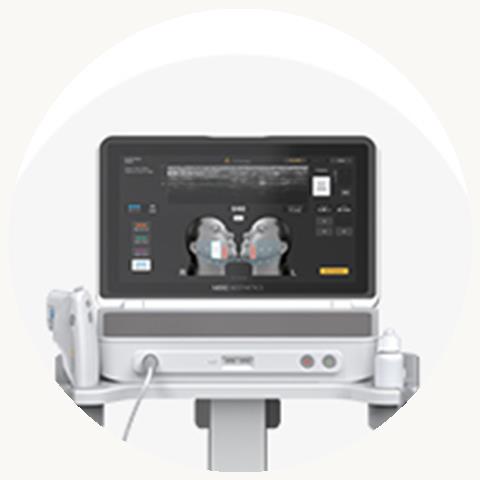
- Focused ultrasound: reaches deeper structural layers; Ultherapy Prime is an example we offer.
- Radiofrequency: heats tissue at a more superficial depth to help firm and tighten; Thermage FLX is one option.
- Thread lifting: supports sagging tissue in selected cases; see thread lifting.
- Filler in the cheeks: can restore support in some faces, which we cover in our guide on cheek filler for jowls.
- Anti-wrinkle injections: used in selected cases to relax muscles pulling the lower face down.
No option suits everyone. The right one depends on your skin, your anatomy and what you want to change.
Ultrasound or radiofrequency?
The two energy types work at different depths and feel different during treatment. Focused ultrasound is often discussed for deeper support, while radiofrequency is often chosen for overall firmness and skin quality. We compare them in detail in Ultherapy vs Thermage. Which is more appropriate for jowls depends on skin thickness, the amount of laxity and your tolerance, and is decided after examination.
What a clinic checks first
A careful assessment looks at how the face moves, where volume has been lost, how loose the skin is and whether weight changes or earlier treatments are involved. The doctor examines the face in person, from the front and from the side, and explains which of the types above appear to be at play. Decisions are not made from photos alone, which matches the principle in our treatment philosophy: diagnose first, then choose.
Risks and limits to understand
- Temporary effects: redness, swelling, tenderness or bruising can occur after lifting or injection treatments.
- Variable results: improvement differs between people, and some jowls need more than a non-surgical approach.
- Uneven or unwanted outcomes: these can occur in uncommon cases and need review by a doctor.
- Ongoing ageing: the face keeps changing, so results are not permanent.
If you notice unusual pain, marked swelling or changes in skin colour after a procedure, contact the clinic promptly. Complication care is available.
What to ask before treating jowls
- Which type of jowl do I have, and how can you tell?
- Is a non-surgical option realistic for my degree of sagging?
- Why this method rather than another, and what are its limits?
- How many sessions are expected, and how will progress be judged?
- What aftercare is needed, and who do I contact if something feels wrong?
Related links
You can see treatment options on the price list, and read Dr. Hyoseung Jang's background on the doctor profile.
References
PubMed - Reviews of facial ageing and the role of ligaments, fat compartments and volume loss
Journal of the Korean Society of Dermatology - Non-surgical facial lifting in Asian skin
Ministry of Food and Drug Safety (MFDS) Medical Device and Drug Safety Information Systems
Frequently Asked Questions
What are jowls?
Jowls are soft tissue that droops below the line of the jaw, blurring the edge between the cheek and the neck. They develop gradually as skin loosens, support structures relax and fat shifts downward, so the cause differs from person to person.
Why do jowls form?
Several things happen together with age: skin loses firmness, the ligaments that hold facial tissue in place relax, volume in the mid-face thins and lower-face fat moves down. Genetics, weight changes and sun exposure also play a part.
Can jowls be lifted without surgery?
Some people see a visible tightening or smoothing with non-surgical care, but the degree varies and it cannot be promised. Marked sagging is often better judged against surgical options, and a doctor can tell you honestly which group you fall into.
Does cheek filler help jowls?
In some faces, restoring support in the cheeks can soften the pull on the lower face. It is not suitable for everyone, and over-filling can look heavy. We explain this in our guide on cheek filler and sagging jowls.
Which lifting device is best for jowls?
There is no single best device. Focused ultrasound and radiofrequency work at different depths and suit different skin and tissue types, so the choice depends on an in-person assessment rather than on a device name.
Can anti-wrinkle injections help jowls?
In selected cases a doctor may use anti-wrinkle injections to relax muscles that pull the lower face downward, mainly as a supporting step beside other care. They do not lift loose skin on their own, and suitability is decided at consultation.
How many sessions will I need?
It depends on the type of jowl, the method chosen and your skin. Some plans are a single session and others are spaced over time. Your doctor sets the plan after examination and reviews progress as you go.
Are there risks?
Any procedure can cause temporary redness, swelling, tenderness or bruising, and less commonly uneven results or other effects that need review. A doctor explains the risks that apply to your chosen method before you decide.
How long do results last?
Results vary by person and method, and ageing continues afterwards, so no fixed duration can be promised. Sun protection, stable weight and follow-up care help keep skin looking its best.
Is the price listed anywhere?
Fees depend on the approach and area, and are listed on our price list. A consultation helps to decide which items you actually need.
Approval information for medical devices and drugs used in treatments can be checked on the Korean MFDS portals Medical Device Safety Korea and Drug Safety Korea.