
"Is 1cc enough, or should I get 2?" is almost always the first question in a lip filler consultation. It's a reasonable thing to want a straight answer to — except there isn't one, because the honest answer depends on a face none of the people asking online can see: yours.
The amount of product is not where a good or bad result actually gets decided. This article explains what does, what the "lip filler gone wrong" photos you've probably seen have in common, who this treatment suits, and what it costs at Gangnam Pieobom Dermatology Skin Clinic.
The question almost everyone starts with — and why it's the wrong one
"How many cc do I need?" treats lip filler like a container you're topping up. In practice, the same 1cc can look refined and natural on one face and slightly odd on another, because the lips don't exist in isolation — they sit between the nose, the chin and the philtrum, and move constantly when you talk, eat or smile.
A face-wide "factory" approach — the same volume, the same shape, applied regardless of the person — is exactly what produces results that read as "done" rather than simply attractive. The more useful question is a different one: given your lip proportions, your philtrum length and how your mouth corners sit, what's the smallest change that gets you the look you actually want?
What actually decides the result
Lip proportion is read against several reference points at once, not against the lips alone:
- The ratio between upper and lower lip volume
- The width of the mouth and the angle of the corners, including any asymmetry
- Philtrum length and its relationship to the nose and chin
- The natural curve of the cupid's bow and the overall line of the lip border
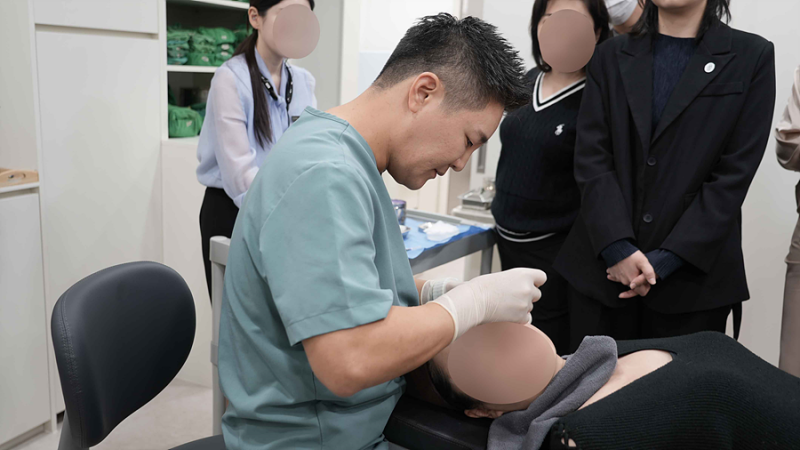
The same volume of filler placed against these reference points can read as sharp and elegant on one face and as unbalanced on another. That's why the real design work happens before the needle — reading these proportions together is what separates a refined result from one that just looks "filled."
What "gone wrong" really looks like, and why it happens
Search "lip filler gone wrong" and most of what comes up shares one root cause: too much volume concentrated in too few injection points, rather than small amounts distributed carefully across many. The visible signs are fairly consistent —
- A lip border that looks blurred or "melted" instead of sharper and more defined
- Lips that look stiff or move unnaturally when talking, eating or smiling
- Visible lumps or unevenness once the initial swelling settles
- A duck-lip profile where projection outpaces the rest of the face
None of these are an inherent property of lip filler — they're what happens when volume is prioritized over design. The fix isn't a different product; it's smaller amounts placed at more points, with the whole lip line — and the face around it — considered as one design, not a space to be topped up.
Who this is a good fit for
The people who tend to be happiest with lip filler share a few starting concerns: a lip border that's blurred enough that lip makeup doesn't hold its line, lips that visibly "roll in" and nearly disappear when smiling, or vertical lip wrinkles that read as older than the rest of the face. In most of these cases, a conservative, well-placed volume change makes a bigger difference than people expect — the goal isn't bigger lips, it's a clearer line and better proportion.
Beyond the visible change, this is also one of the more psychologically immediate treatments we do. People who used to avoid photos or cover their mouth when laughing because of a lip complex often relax into their expression noticeably once the border reads as clean and intentional rather than uncertain.
Product, technique and real pricing
At Gangnam Pieobom Dermatology Skin Clinic, lip filler draws on Belotero, a German HA filler built on CPM (Cohesive Polydensified Matrix) technology designed for tight tissue adherence and a lower risk of lumps or delayed swelling. Belotero itself spans four sub-types — Soft, Balance, Intense and Volume, formulated for different depths and tissue types — and lip work typically uses a selection from within that range rather than one fixed product.
Technique matters as much as product choice here. Because lips are thin-skinned and in near-constant motion, the micro-amount, multi-point approach described above isn't a stylistic preference — it's what keeps the result moving naturally with your expression instead of against it.
Current pricing for special-area HA filler (lips) at Gangnam Pieobom Dermatology Skin Clinic is KRW 690,000 per 1cc (Juvéderm, Restylane or StyleAge), or KRW 300,000 per 1cc for Amalian, a more budget-conscious HA line. You can see this alongside every other filler and treatment area on the filler price list. Prices may vary with the scope of treatment and your specific condition, and the final amount is confirmed at consultation.
Why the injector matters more than the product
Lips are a small area with a dense network of blood vessels and nerves running through them, which means small technique differences show up as large differences in the final result — and, in rare cases, in safety. This is a treatment where experience genuinely changes the outcome.
Gangnam Pieobom Dermatology Skin Clinic's Medical Director, Dr. Hyoseung Jang, is President of the Korean Association of Clinical Aesthetic Medicine and holds Allergan's JUVÉDERM Product Master certification as Korea's first certified recipient, alongside Allergan Medical Institute (AMI) Faculty Master status and a Key Opinion Leader role for Daehwa Pharmaceutical's Amalian filler line. He personally handles every consultation, design and injection — not a template applied by rotating staff. You can read his full academic background on Dr. Jang's profile.
If anything about your lips, face or medical history makes you want extra reassurance before treatment — previous filler elsewhere, a clotting condition, or simply wanting to understand the safety side in more depth — ask about it directly at consultation; the clinic also runs a dedicated complication care service for exactly these situations.
Fitting it into a trip to Seoul
Compared to multi-session treatments, lip filler is usually a single, same-day visit — consultation, design and injection in one appointment — which makes it one of the more travel-friendly treatments to plan around a short trip. Mild swelling and occasional light bruising are common in the first day or two, so most travelers prefer scheduling it earlier in a Seoul trip rather than the day before a flight.
Gangnam Pieobom Dermatology Skin Clinic is on the 3rd floor at 365 Gangnam-daero, directly in front of Gangnam Station Exit 5. Booking runs through WhatsApp — send a daylight photo of your face, your main concern, and your travel dates, and we'll outline a realistic plan before you arrive. See how to find us for directions and hours.
Frequently Asked Questions
How much lip filler do I actually need, 1cc or 2cc?
There's no single correct amount. 1cc is often enough for refining the lip border and balancing proportion without a visible change in size. 2cc is usually considered when the lips are genuinely thin and under-volumed on both the upper and lower lip, or when a longer-looking philtrum is part of the concern. Either way, the amount is set against your face, not picked from a menu.
What does "lip filler gone wrong" actually look like, and how is it avoided?
Most of what gets called "gone wrong" online comes from too much volume placed in too few points, which blurs the lip border instead of sharpening it and can make the lips look stiff when talking or smiling. It's avoided by injecting small amounts across multiple precise points rather than bulk-filling one area, and by treating the lips as part of the whole face — philtrum length, mouth corner angle, nose and chin position — rather than in isolation.
Are lip filler nodules common?
They're uncommon with modern HA fillers placed correctly, but they're one reason product choice and injection technique matter. A filler designed for fine, mobile tissue, placed at the right depth and in small amounts, lowers the risk considerably. If a nodule or lump does appear, it can usually be addressed at a follow-up visit.
Is vascular occlusion a real risk with lip filler?
It's a rare but serious complication possible with any facial filler, including lip filler, which is exactly why anatomical knowledge and injection technique matter more than the product itself. Choosing a clinic with genuine experience in this specific area, and one that has a complication-care protocol in place, is the most meaningful way to reduce that risk.
How long does lip filler last?
Results commonly last several months to around a year, though this varies by individual metabolism, the product used and how much movement the lips get day to day. Because hyaluronic acid filler breaks down gradually and naturally, touch-ups rather than full redo treatments are typical.
Can lip filler be combined with other treatments?
Yes. It's commonly planned alongside skin boosters for overall lip hydration and texture, or alongside other facial balancing treatments such as chin or nose filler when the goal is proportion across the whole lower face rather than the lips alone. The combination and order are set at consultation.
Approval information for medical devices and drugs used in treatments can be checked on the Korean MFDS portals Medical Device Safety Korea and Drug Safety Korea.