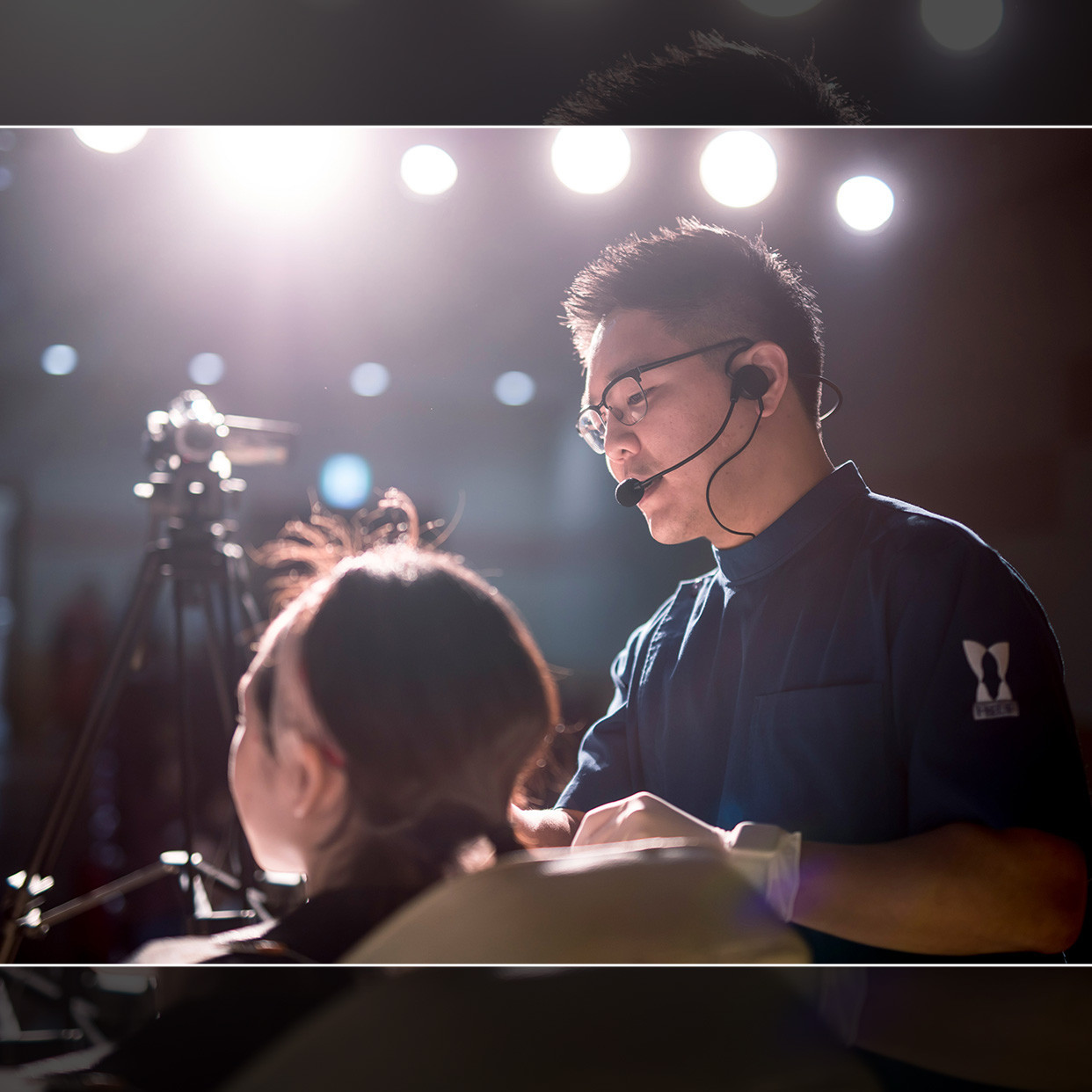
In June 2026, Dr. Hyoseung Jang was invited to a Buchang Pharmaceutical clinical event in Seoul to teach a group of physicians visiting from China — the topic was temple filler and ear filler technique specifically, using live clinical video to walk through entry point selection, depth and fascial resistance, and dual-injection methods for the temporal region.
That kind of invitation doesn't happen by accident — brands and academic organizers ask doctors with real, demonstrable technique to teach other doctors, not the other way around. It's also a useful entry point into this article, because the single most common mistake in this category isn't about product or volume. It's treating the temple and the forehead as two separate problems when they're really one.
Why forehead and temple have to be read together
A deep temple hollow next to a forehead that's been filled on its own doesn't read as "forehead: fixed." It usually reads as the hollow being more obvious, because the surrounding area no longer matches it. The reverse happens too — a temple that's been filled while the forehead itself stays flat can leave the center of the face looking unbalanced against the sides.
This is why a forehead consultation that only measures the forehead is an incomplete consultation. The actual design question is how the brow line, the temple hollow and the forehead curve read together as one continuous side profile, from the hairline down to the cheekbone.
What a well-designed forehead line actually looks like
There's a real proportion reference behind what reads as a "good" forehead, rather than it being purely subjective. Divide the distance from the hairline to the eyebrows into three; a line that projects slightly forward at roughly the lower third tends to read as visually stable and balanced. A side profile angled at roughly 85 degrees from vertical — very slightly reclined rather than perfectly upright — tends to read as more natural than a steep, vertical forehead.
Volume isn't a fixed number. A commonly cited starting range is about 3cc to 5cc, but depending on how hollow the area is and how much change is wanted, it can run to 10cc or more. What matters more than the number is how it's distributed: injecting without respecting the skull's existing curve is what produces a bumpy surface or an artificially domed ("bulging") forehead — the single most common complaint about forehead filler done elsewhere. Compared with fat grafting, filler has a real advantage here: there's no survival-rate variability to plan around, and the result is visible immediately rather than depending on how much of a fat graft takes.

Temple filler: the area that gets overlooked
Temple hollowing is easy to miss in the mirror but shows up clearly in photos taken slightly off-angle, where it can read as a tired or aged side profile. Temple filler fills that hollow to smooth the transition from brow to hairline to cheekbone, and the injection depth is set individually based on skull structure and how much fat layer is already present in the area — not a single standard depth for everyone.
Because the forehead's skin layer is thin and its vascular network is relatively dense and complex, a uniform, thin layer placed directly above the bone (rather than a thicker, less controlled application) is what keeps both the forehead and temple from developing an uneven surface as swelling resolves.
Ear filler: the related procedure most people haven't heard of
Ear filler was part of the same June 2026 teaching session, and it addresses a specific, less commonly discussed concern: ears that sit flattened against the head or appear asymmetrical. Adding volume lets the ear's natural line show from a front-facing view instead of disappearing against the head, and as a secondary effect, it can make the mid-face read as slightly shorter and more proportionate.
It's a niche request, but it's exactly the kind of detail-area work that benefits from a doctor who has specifically studied and taught the technique, rather than one applying general facial-filler experience to an area with its own distinct anatomy.
How long it lasts, and when a touch-up makes sense
Forehead filler tends to last longer than filler placed in more mobile areas of the face, simply because the forehead is a wide surface with comparatively little movement. That doesn't mean it's permanent — volume can settle and redistribute gradually, so a check-in and small top-up months later is a normal part of maintaining the result, not a sign anything went wrong the first time.
Muscle movement is also worth planning around. People with very expressive foreheads — frequent eyebrow-raising, strong frown lines — sometimes find filler shifts position faster, in which case a small amount of anti-wrinkle injection is added to help the filler hold its shape for longer. Preference also varies by who's asking: women more often ask for a soft, rounded curve, while men more often ask for a straighter, more linear line with balanced volume rather than a pronounced curve — both are design starting points, not rules.
Pricing and aftercare
At Gangnam Pieobom Dermatology Skin Clinic, forehead and temple filler is priced as a general treatment area: KRW 450,000 per 1cc for premium HA filler (Juvéderm, Restylane or StyleAge), or KRW 210,000 per 1cc for Amalian. Ear filler is priced separately at KRW 390,000 per 1cc. You can see these alongside every other treatment area on the filler price list. Prices may vary with the scope of treatment and your specific condition, and the final amount is confirmed at consultation.
Afterward, avoid pressing or massaging the treated area — including facial massage treatments — for the first few days, and skip sauna visits or intense exercise for a short period, since both can affect how the filler settles into its final shape. Dr. Jang personally oversees consultation, design and injection for forehead and temple filler at Gangnam Pieobom Dermatology Skin Clinic; you can read his full academic background, including his international teaching history, on his profile.
Frequently Asked Questions
How much filler does the forehead usually need?
There's no fixed amount. A commonly cited range is about 3-5cc, but it can run to 10cc or more depending on how hollow the area is and how much volume is actually wanted. The right amount is set against your skull shape and skin thickness, not picked from a standard number.
How long does temple or forehead filler last?
Forehead volume tends to last longer than in most other facial areas, because the forehead has a wide, relatively low-movement surface. That said, volume can settle and redistribute gradually over time, so a follow-up check and small adjustment later is common rather than unusual.
Can forehead filler end up looking unnatural or "bulging"?
Yes, if the volume doesn't account for the skull's existing curve. Injecting too much without respecting the natural contour can create a surface that looks uneven or an artificially domed forehead. The fix is a thin, carefully layered amount set against your own bone structure, not a larger volume applied more aggressively.
Can temple or forehead filler be combined with anti-wrinkle injections?
Yes, and it's a common pairing for people with very expressive foreheads. Frequent muscle movement can gradually shift or compress filler volume over time, so a small amount of muscle-relaxing injection is sometimes added to help the filler hold its position and shape for longer.
What is ear filler, and who is it for?
Ear filler adds volume to ears that sit flattened against the head or appear asymmetrical, so the ear line is visible from a front-facing view rather than hidden. As a side effect of the added volume and angle, the mid-face can also read as slightly shorter and more balanced.
What should I avoid after temple or forehead filler?
Avoid pressing or massaging the treated area, including facial massage treatments, for the first few days. Sauna visits and intense exercise that raises blood flow and sweating significantly should also be avoided for a short period, since both can affect how the filler settles.
Approval information for medical devices and drugs used in treatments can be checked on the Korean MFDS portals Medical Device Safety Korea and Drug Safety Korea.